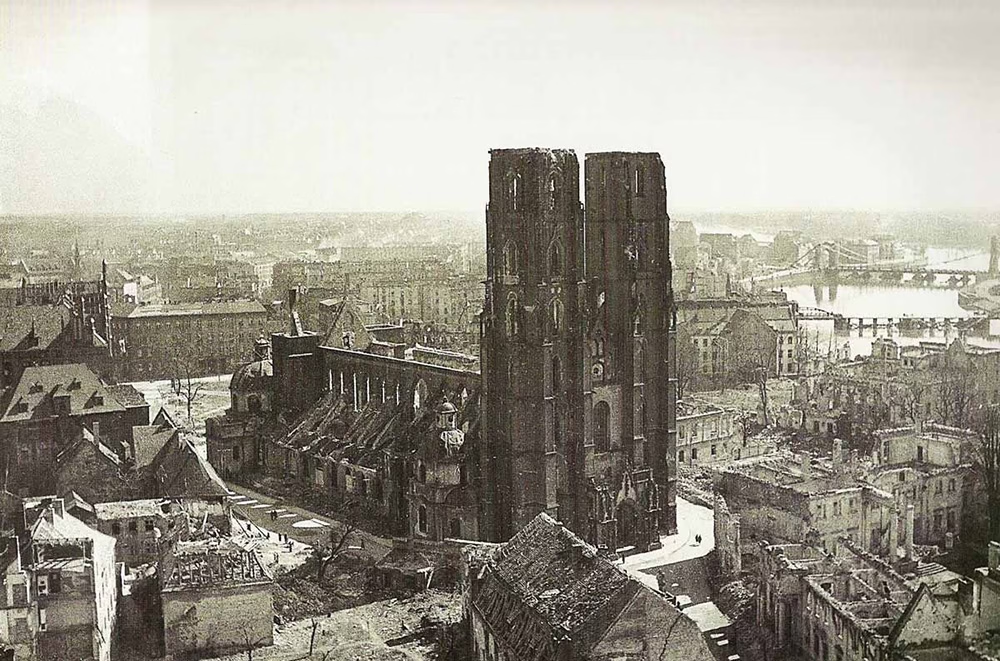
By the spring of 1945, Breslau (today’s Wrocław) had become one of the last major German cities still fighting for the Third Reich. Berlin crumbled, and Soviet armies pushed towards central Germany. Hitler ordered Breslau to hold out as a Festung, or fortress, regardless of the cost. What followed was one of the longest and most destructive urban battles of the Second World War.
The Siege of Festung Breslau lasted almost 80 days. It reduced the city to ruins and trapped hundreds of thousands of civilians alongside soldiers, forced labourers and refugees. Entire neighbourhoods became battlefields. Historic buildings were demolished for military purposes. An emergency airstrip was carved through a residential district. Nazi officials continued demanding resistance long after Germany’s defeat had become inevitable.
Despite its scale, the Battle of Breslau remains far less familiar than Stalingrad, Budapest or Berlin. Yet its legacy shaped the post-war reconstruction of Wrocław and marked the violent end of German Breslau. This story explains how present-day Wrocław became a fortress, how the siege unfolded, and how it transformed into the stunning Central European city we see today.
(Note: Historical sources differ on casualty figures. The precise chronology of military decisions and certain events during the final days of Festung Breslau. Where significant disagreements exist, this article follows the broad consensus of modern scholarship or identifies the differing interpretations.)
Why Hitler Declared Breslau a Fortress
The decision to turn Breslau into Festung Breslau reflected the rapidly deteriorating military situation on the Eastern Front during 1944. Following the destruction of Army Group Centre and the Soviet advance into eastern Europe, Hitler expanded a network of designated fortress cities. The intention was to delay the Red Army’s advance. Breslau was formally included in this system on 25 August 1944, although planning and political decisions had begun weeks earlier.
The city was chosen for both strategic and symbolic reasons. It controlled major railway routes, road links and crossings over the Oder, while serving as the administrative centre of Lower Silesia. Nazi leaders also regarded Breslau as a prestigious German city that could not be surrendered without undermining propaganda. They promised the Soviet advance would be halted. The result was a policy that prioritised prolonged resistance over civilian safety. It transformed a functioning city into a battlefield before the siege had even begun.
Suggested read: Owl Mountains – A WWII Story of Ambition, Secrecy, Collapse, and Myth
What Does “Festung Breslau” Mean
The German word Festung means “fortress”. During the final phase of the Second World War, Adolf Hitler designated strategically important cities as Festungen (fortresses). The orders were to resist until the last possible moment, regardless of military circumstances. Festung Breslau was one of the largest and longest-defended of these fortress cities. The designation carried both military and political significance. Commanders were expected to hold the city even when encircled. Civilian administration was subordinated to the demands of the fortress defence.
Breslau Before the Siege
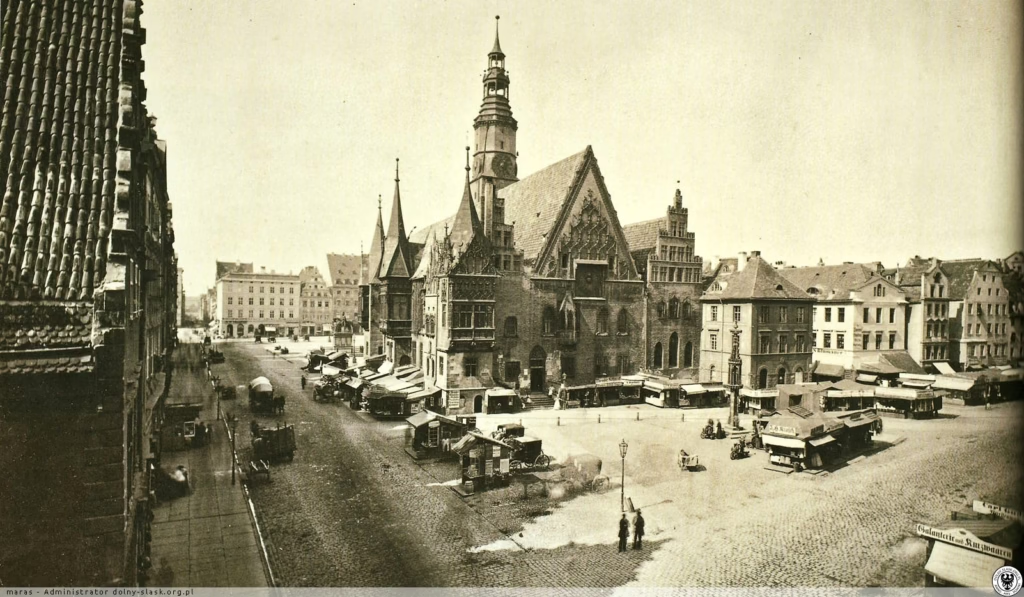
Image courtesy of Fotopolska
In 1944, Breslau was one of the largest cities in Nazi Germany and the administrative capital of Lower Silesia. Unlike Berlin, Hamburg or Cologne, it had escaped the sustained Allied bombing campaigns that devastated much of the Reich. Trams still ran, factories remained productive, railway stations were busy, and municipal services continued to function despite occasional Soviet air raids.
Before the war, Breslau’s population stood at around 630,000. By January 1945, that figure reached nearly one million. This was because refugees from eastern territories and evacuees from bombed German cities poured into what many believed was one of the safest places. Forced labourers and prisoners also formed a significant part of the city’s population.
Its strategic position made Breslau indispensable. Major railways, road connections and bridges across the Oder River linked Upper Silesia, Berlin, Bohemia and central Germany. Military importance, combined with its status as the centre of Nazi administration in Lower Silesia, ensured Breslau would become a key target during the Soviet advance.
Preparing Festung Breslau
Following Breslau’s designation as a fortress, military preparations accelerated throughout the autumn of 1944. Existing fortifications were reinforced, anti-tank ditches and trench systems expanded, and key public buildings identified for conversion into defensive strongpoints. Ammunition, food and medical supplies were stockpiled while hospitals prepared for prolonged combat inside the city.
Much of the construction relied on compulsory labour. German civilians, Organisation Todt units, foreign labourers and prisoners were mobilised to dig defences, build barricades and strengthen military positions. At the same time, the Volkssturm, Germany’s last-ditch home guard, recruited older men and boys with little military training but were expected to defend the city. Similar fortress policies were introduced in cities including Königsberg, Poznań and Küstrin. Yet Breslau would become one of the most prolonged examples of Hitler’s Festung strategy.
The Delayed Evacuation of Breslau
As the Red Army advanced through Poland in January 1945, the military recognised that Breslau’s civilian population should be evacuated before the city was encircled. Gauleiter Karl Hanke resisted those plans for months. An early evacuation would have exposed the reality, contradicting Nazi propaganda that promised the war remained under control.
Only on 19 January 1945 did Soviet forces reach Lower Silesia, and transport routes were already overwhelmed. Hanke ordered civilians not considered essential to the defence to leave the city. The decision came too late. Railway stations became gridlocked, while tens of thousands of women, children and elderly residents were forced to continue on foot through deep snow. They endured temperatures of -20 degrees. They marched towards Dresden and other destinations west of Breslau.
Around 700,000 people eventually left the city. About 150,000 civilians remained inside Festung Breslau when the Soviet encirclement closed in mid-February. Most of them were Volkssturm fighters, hospital patients, municipal workers, forced prisoners and families with nowhere left to escape. The chaotic evacuation became a defining tragedy of the Siege of Breslau. It showed how political ideology repeatedly took precedence over civilian lives.
Who Controlled Festung Breslau?
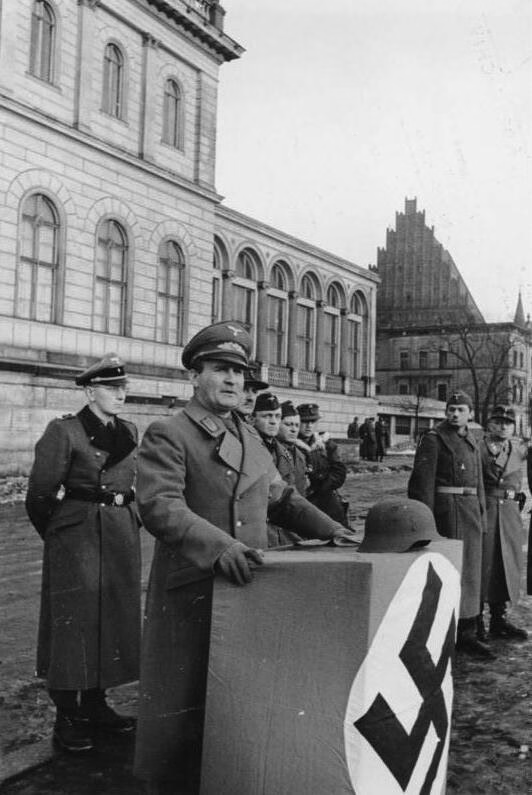
Power inside Festung Breslau was divided between the German military and the Nazi Party. In practice, Gauleiter Karl Hanke dominated the city’s political life. As Gauleiter and Reich Defence Commissioner for Lower Silesia, he controlled propaganda, civilian mobilisation, the Volkssturm, often overriding military advice. Karl Hanke answered directly to Adolf Hitler and exercised authority that frequently exceeded that of the military command.
Military leadership changed as the crisis deepened. General Johannes Krause became the first fortress commandant in 1944 but was replaced by General Hans von Ahlfen shortly before the Soviet encirclement in February. In March 1945, General Hermann Niehoff assumed command and directed the defence until the city’s surrender.
This divided leadership frequently produced conflict. While army commanders focused on tactical defence, Hanke insisted that Breslau must never be surrendered. His influence extended far beyond military matters, affecting labour allocation, civilian administration, and more. From headquarters near today’s Bastion Sakwowy and government buildings close to modern plac Powstańców Warszawy, the Nazi leadership continued directing the city’s defence even as fighting spread through central Wrocław. Military necessity and political fanaticism defined the Battle of Breslau.
Emergency Rule Inside Festung Breslau
Life inside Festung Breslau was governed by far more than military orders. As Soviet forces approached, Breslau became an enclosed city where the Nazi Party, the Wehrmacht and the police exercised overlapping powers. It placed civilians under emergency control. Residents were ordered to dig trenches, construct barricades, clear rubble or transport ammunition. Homes, businesses and public buildings were requisitioned for military use, while movement between districts became increasingly restricted. Blackout regulations remained strictly enforced, and anyone accused of defeatism, desertion or refusing assigned work risked arrest, summary trial or execution.
One of the clearest examples came on 28 January 1945, when Deputy Mayor Wolfgang Spielhagen was publicly executed after being accused of advocating the abandonment of the city. His death was intended as a warning that loyalty to the regime outweighed any consideration of military reality or civilian welfare. Although municipal departments continued to distribute food, maintain hospitals and repair damaged infrastructure where possible, political ideology dictated every major decision.
How the Soviet Encirclement Closed Around Festung Breslau
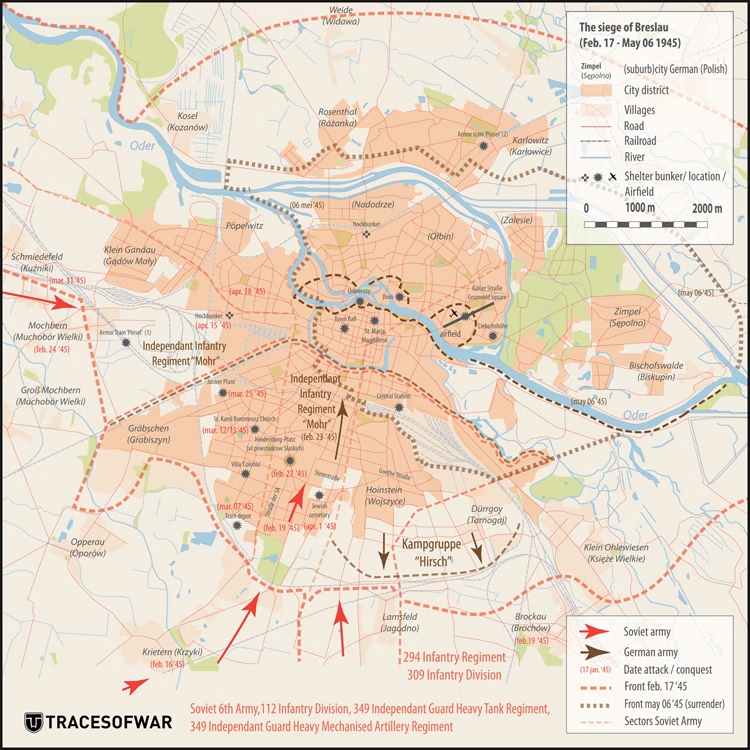
Image courtesy of TracesOfWar
The Siege of Breslau began long before Soviet troops entered the city itself. During the Vistula–Oder Offensive, Marshal Ivan Konev’s 1st Ukrainian Front advanced rapidly across southern Poland, bypassing strongpoints where possible to maintain momentum towards Berlin.
Rather than launching an immediate assault against Breslau’s strongest northern defences along the Oder, Soviet forces swept around the city from the south and west. Their objective was to isolate the fortress, sever its transport links and leave a reduced force to eliminate the garrison while the main Soviet armies continued westwards.
By the night of 15–16 February 1945, Soviet pincers met west of Breslau, completing the encirclement. Depending on the most widely established chronology by historians, the siege lasted 80 days, ending with the German capitulation on 6 May 1945.
Inside the pocket remained about 50,000 German defenders, supported by Volkssturm battalions, police units, Hitler Youth formations and Luftwaffe personnel. Alongside them were nearly 150,000 civilians confined within a shrinking battlefield. It stretched from the southern suburbs towards today’s Wrocław Old Town, Rynek and the historic islands of the Oder. The fortress had become strategically isolated. Yet its defenders continued fighting, forcing the Red Army into one of the longest urban sieges of the Second World War.
Why Festung Breslau Held Out for Nearly 80 Days
Given Germany’s collapsing military position in early 1945, the prolonged defence of Festung Breslau appears surprising. Yet several military and logistical factors combined to make the fortress one of the last major German strongholds to surrender in Europe.
The garrison eventually numbered around 50,000 men. Experienced Wehrmacht and Waffen-SS units fought alongside Luftwaffe personnel, police formations, Volkssturm battalions and Hitler Youth members. While many defenders lacked training or modern equipment, the city’s dense urban landscape favoured defence over attack.
Soviet strategy also played a decisive role. Rather than committing overwhelming forces to Breslau, the Red Army assigned the task to the Soviet 6th Army while its main formations continued advancing west. The Red Army lacked the numerical superiority normally considered necessary for large-scale urban assaults.
German air force further prolonged the siege. Until the capture of Gądów (Gandau) airfield in early April, the Luftwaffe maintained an air bridge that delivered ammunition, medical supplies and specialist troops while evacuating selected wounded personnel. Even after the airfield was lost, limited resupply continued through parachute drops and occasional light aircraft.
None of these factors could change the outcome of the war. Together, however, they explain why the Siege of Breslau continued for so long.
How the Battle of Breslau Destroyed the City Street by Street
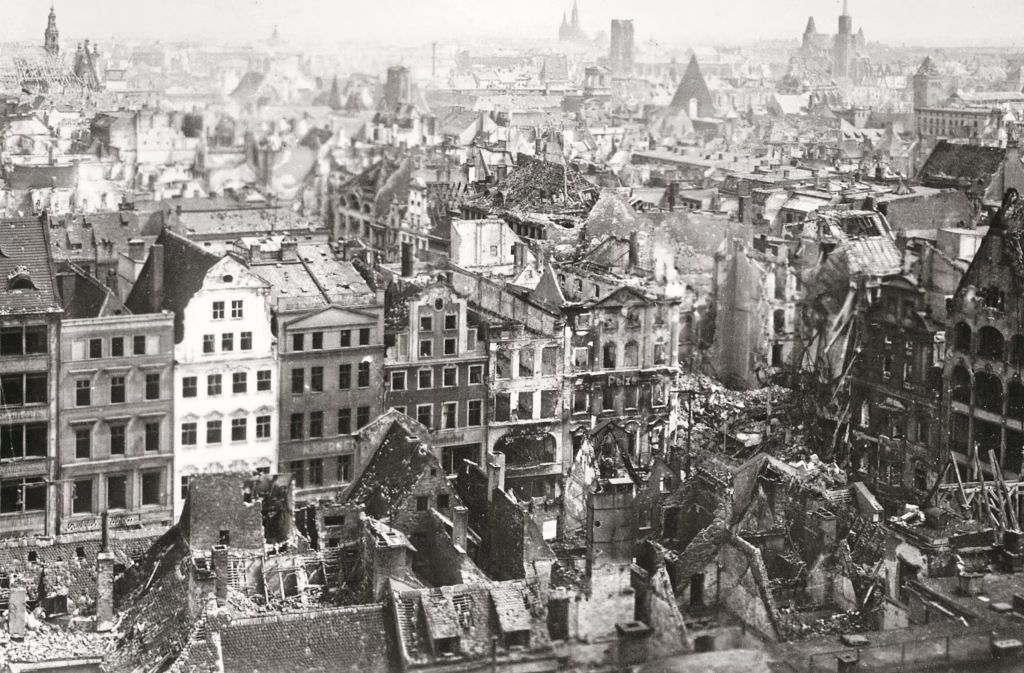
Image courtesy of Polska na fotografii
Once the Soviet encirclement was complete, the Battle of Breslau developed into a brutal campaign of street fighting that advanced neighbourhood by neighbourhood. The heaviest attacks came from the south and south-west, where open ground offered the most practical approach into the city.
Fighting spread through districts including Ołtaszyn, Wojszyce, Klecina, Borek, Grabiszyn and Gajowice. Finally, it reached industrial areas, railway embankments and densely built residential streets. German engineers converted houses into strongpoints by knocking passages through adjoining walls, allowing defenders to move between buildings under cover. Cellars became shelters, command posts and ammunition stores, while upper floors served as observation points and machine-gun positions.
The Red Army adapted with specialised assault groups supported by heavy artillery, flamethrowers and fire guns. They fought through gardens, courtyards and breached buildings, reducing one city block after another.
As pressure intensified on the western districts, the loss of Gądów airfield threatened Breslau’s last reliable air link. German authorities responded by demolishing part of the built-up area around today’s Plac Grunwaldzki to construct an emergency runway. Thousands of civilians and forced labourers carried out the work under constant artillery fire, sacrificing homes, churches and entire streets.
By April 1945, the front had reached districts that are now among Wrocław’s best-known historic areas. Around Rynek, Ostrów Tumski and Wyspa Piasek, artillery bombardment, fires and deliberate demolitions turned one of Central Europe’s finest urban centres into a devastated battlefield.
Everyday Life Inside the Besieged City
For those trapped inside Festung Breslau, survival depended as much on endurance as it did on military events. Fierce fighting engulfed the southern and western districts, while life continued in the cellars, shelters and damaged buildings.
Families shared cramped underground spaces with wounded soldiers, refugees and neighbours. As bombardment intensified, adjoining cellar walls were broken through to create escape routes between buildings, allowing residents to move without entering streets exposed to artillery or sniper fire.
Although Breslau had entered the siege with substantial food reserves, distributing supplies became increasingly difficult. Damaged roads, constant shelling and the collapse of transport networks separated warehouses from those who needed them most. Communal kitchens and rationing remained in operation, but shortages steadily worsened.
Electricity and gas failed as infrastructure was damaged, while broken water mains forced residents to rely on pumps, wells and the Oder. Hospitals relocated into churches, schools and reinforced public buildings, where doctors worked with dwindling medicines and improvised equipment. Trams briefly continued on shortened routes before abandoned carriages were turned into street barricades.
Even in such conditions, municipal workers repaired utilities, firefighters battled blazes with limited water supplies, and medical staff treated civilians and soldiers. The resilience of Breslau’s inhabitants stood in stark contrast to the increasingly hopeless military situation surrounding them.
Forced Labour and the Construction of the Grunwaldzki Airstrip
As the Festung Breslau siege tightened, the distinction between civilian employment and military service all but disappeared. Men and women, alongside foreign forced labourers and prisoners, were ordered to dig trenches, build barricades, carry ammunition, clear rubble, and recover the wounded.
One of the most controversial projects was the construction of an emergency runway along Kaiserstraße, today’s Plac Grunwaldzki. After Soviet forces threatened Gądów airfield, German authorities decided to create a new landing strip by demolishing a broad corridor through the residential district. Homes, public buildings and the Lutherkirche were destroyed to create the improvised runway. Prisoners from the Burgweide forced-labour camp were among those assigned to the project.
The airstrip symbolised the priorities of the Nazi leadership during the final months of the war. Entire sections of Breslau were sacrificed for a military solution that offered only limited practical value. Although the landing ground was used by light aircraft, it never replaced the operational capacity of Gądów airfield. Today, Plac Grunwaldzki is one of Wrocław’s busiest transport hubs. Few visitors realise that beneath its post-war reconstruction lies one of the most striking examples of how Festung Breslau reshaped the city.
Easter 1945: When Breslau Burned
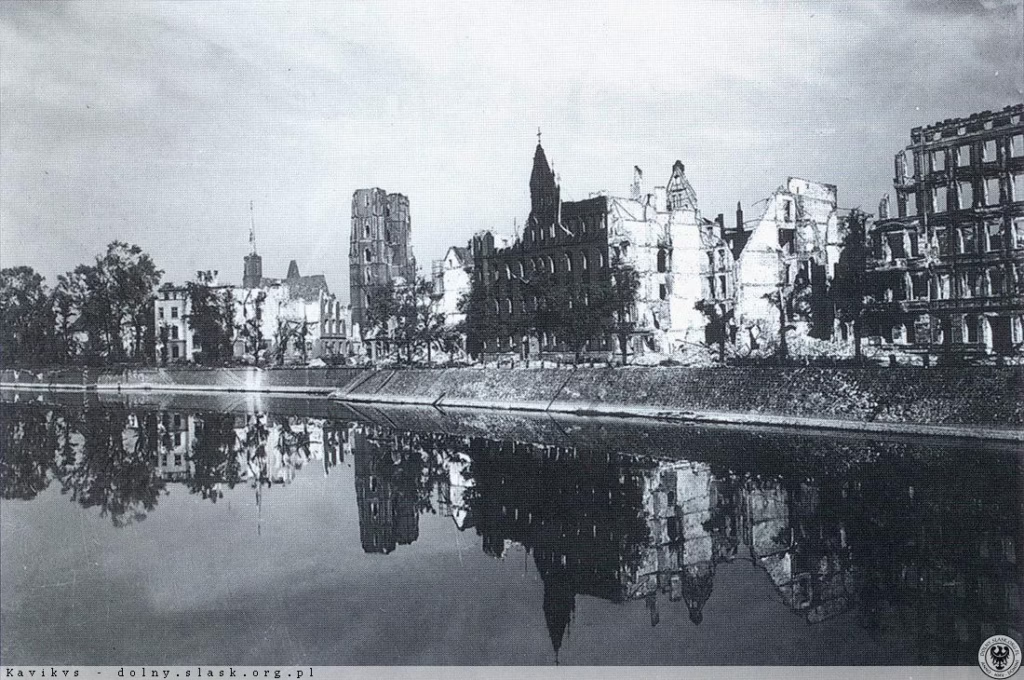
Image courtesy of Polska na fotografii
By the end of March 1945, Festung Breslau had become a city under constant bombardment. The most devastating phase of the siege came over Easter, when Soviet artillery and aircraft unleashed a sustained assault that ignited fires across the historic centre.
Between 1 and 2 April, high-explosive and incendiary bombs struck densely built districts around today’s Rynek, Wyspa Piasek and Ostrów Tumski. Damaged water mains left firefighters unable to control the growing infernos, while blocked streets prevented emergency crews from reaching many of the worst-hit areas. The destruction extended beyond Soviet bombardment. German defenders demolished buildings to improve fields of fire, strengthen barricades and deny cover to advancing troops. Together, artillery, aerial attacks, deliberate demolitions and uncontrolled fires destroyed Breslau.
Despite the scale of the devastation, the city did not collapse. The German defensive perimeter contracted, but organised resistance continued even as Soviet armies fought in Berlin. Militarily, Festung Breslau no longer influenced the outcome of the war. Politically, however, the fortress had to resist until the very end.
The Final Days of Festung Breslau
April 1945 exposed the futility of Breslau’s continued resistance. News of Adolf Hitler’s suicide reached the fortress on 30 April. Two days later, Berlin surrendered. Any realistic hope of relief had disappeared. Behind the front lines, conditions deteriorated rapidly. Ammunition depended increasingly on limited air drops, hospitals overflowed with casualties, and damaged infrastructure left entire neighbourhoods without reliable water or electricity.
Within the military command, General Hermann Niehoff recognised that further resistance would achieve little beyond additional civilian and military losses. On 4 May, representatives of the Protestant and Catholic churches urged him to end the fighting before more of Breslau was destroyed.
The decision marked a decisive break between political ideology and military reality. While Hanke prepared his escape, the officers responsible for defending Festung Breslau quietly began exploring the terms that would bring one of the Second World War’s longest urban sieges to an end.
Karl Hanke’s Escape and the Fall of Festung Breslau
In the early hours of 6 May 1945, Gauleiter Karl Hanke abandoned Breslau using a light Fieseler Fi 156 Storch aircraft. He escaped from the improvised runway at today’s Plac Grunwaldzki, leaving General Hermann Niehoff and the remaining garrison to face the inevitable surrender.
Later that day, General Niehoff signed the surrender agreement at Villa Colonia, on present-day ul. Rapackiego in the Krzyki district. At 18:50 on 6 May 1945, organised resistance officially ended. German soldiers laid down their arms and entered Soviet captivity, bringing the Siege of Festung Breslau to a close just two days before Germany’s unconditional surrender took place.
The Human and Physical Cost of the Siege of Breslau
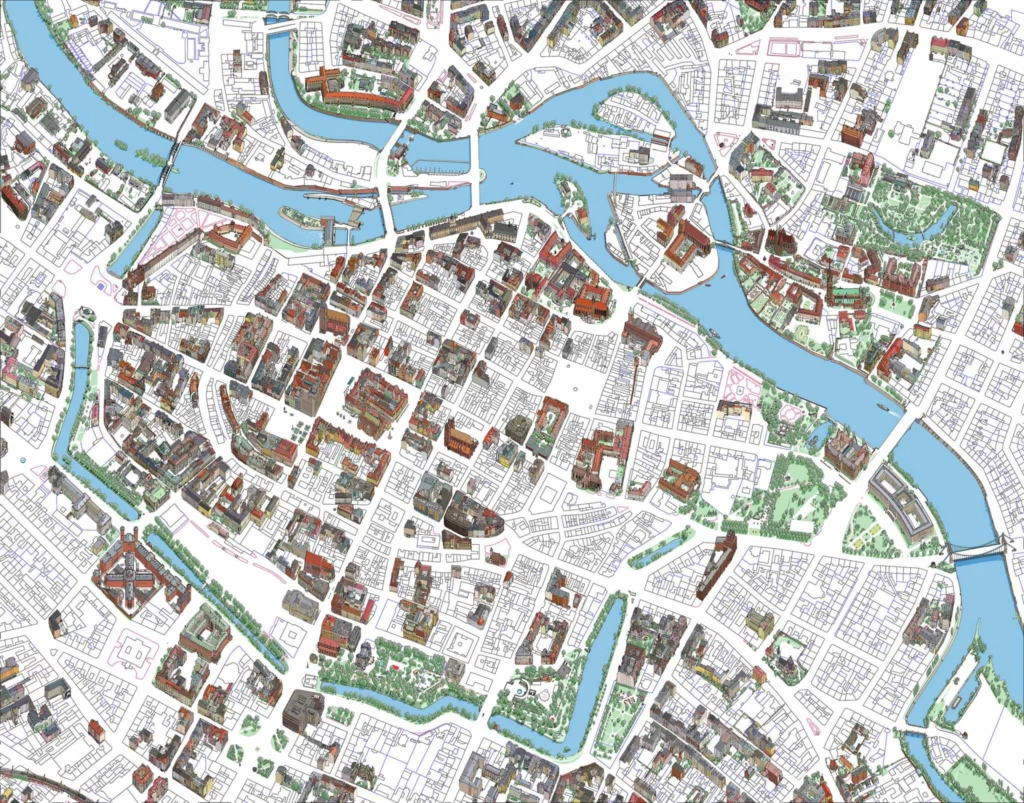
Image courtesy of TracesOfWar
The surrender revealed the full scale of Breslau’s destruction. The southern and western districts, where the fiercest ground fighting had taken place, suffered the heaviest damage, while parts of the northern and eastern suburbs remained comparatively intact. Across the city, public buildings, churches, homes, factories and transport infrastructure lay in ruins. Post-war assessments estimated that around two-thirds of Breslau’s urban fabric had been destroyed, although the extent of damage varied considerably between districts.
Alongside Stalingrad, Budapest, Manila and Berlin, the Siege of Breslau ranks among the Second World War’s most destructive urban battles. Casualty figures remain disputed. Soviet archival records indicate around 8,000 soldiers killed and more than 24,000 wounded. German sources report about 6,000 killed and 23,000 wounded, with about twenty thousand more entering Soviet captivity after the city’s surrender. Some historians have argued for substantially higher German losses. Civilian casualties are even more difficult to establish. Around 80,000 deaths inside the besieged city is the estimate most frequently cited. Broader estimates include civilians who died during the January 1945 evacuation, raising the overall death toll associated with Breslau’s final months to around 180,000.
From German Breslau to Polish Wrocław: The Legacy of a Fortress
When Soviet forces entered the ruined city, the history of German Breslau came to an end. In the months that followed, the city’s population changed almost completely as Germans were expelled and Polish settlers, many displaced from territories annexed by the Soviet Union, arrived to rebuild what had been left behind. Historic landmarks including the Market Square (Rynek), Ostrów Tumski and surrounding streets were restored over decades. While entire districts were redesigned to meet the needs of a post-war Polish city. Beneath the rebuilt Wrocław, the traces of Festung Breslau remain.
Today, locations such as Plac Grunwaldzki, Bastion Sakwowy, Wyspa Piasek, Rynek and the banks of the Oder River reveal scars from WWII. It shows how one of Europe’s oldest cities became a fortress, survived one of the Second World War’s longest sieges, and emerged as modern Wrocław.
Visit the WWII Sites in Wrocław Today
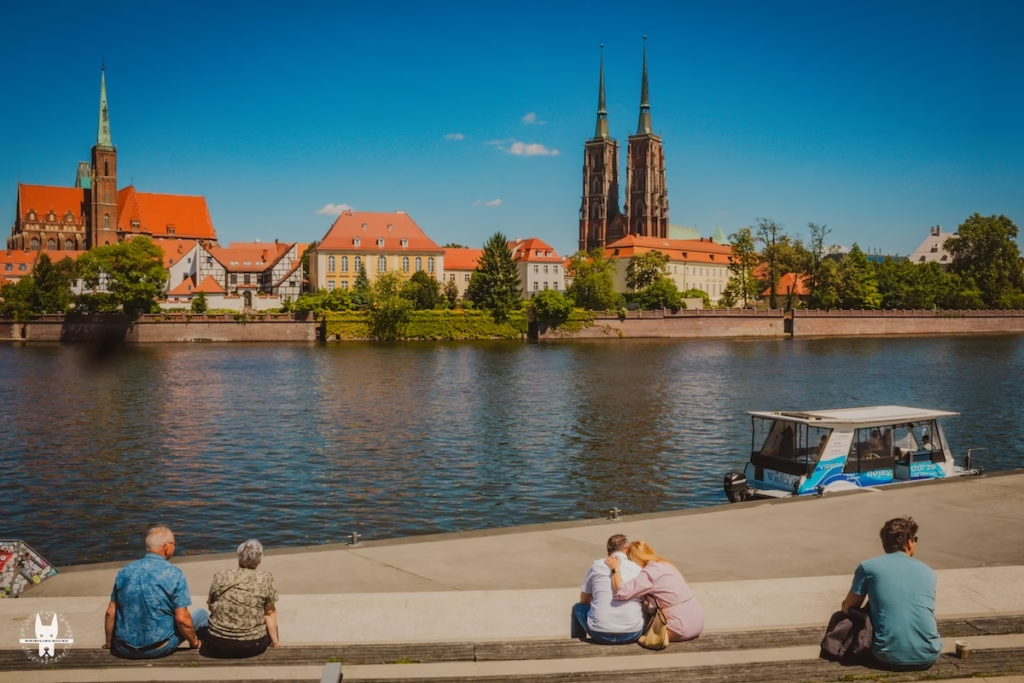
Eighty years after the siege, modern Wrocław reveals the signs of the destruction that once engulfed the city. The rebuilt façades of the Market Square (Rynek), the peaceful streets of Ostrów Tumski and the busy transport hub at Plac Grunwaldzki conceal a landscape shaped by the war. The significance lies in how these places connect to the story of the siege, the Nazi administration, civilian survival and the city’s remarkable post-war transformation into modern Wrocław.
If you’re visiting Wrocław and want to explore this history beyond museums and information panels, my Festung Breslau Walking Tour of Wrocław follows the siege across the city itself. Over four hours, we trace the headquarters, defensive positions, surviving landmarks and key battle locations, placing them within the broader history you’ve just read. It is designed for military history enthusiasts and anyone seeking a deeper understanding of one of Europe’s most remarkable wartime stories.
Tour duration: 4 hours
Route: Rynek → Plac Solny → Royal Palace → Plac Wolności & the NFM → Wrocław Opera → Bastion Sakwowy → Blessed Czesław’s Chapel → former Hatzfeld Palace → Nowy Targ → Piasek Island → Ostrów Tumski
Key Figures of Festung Breslau
Karl Hanke – Gauleiter of Lower Silesia and the city’s political leader.
Johannes Krause – First fortress commandant.
Hans von Ahlfen – Reorganised the city’s defence before the encirclement.
Hermann Niehoff – Final commandant who surrendered Breslau on 6 May 1945.
Ivan Konev – Commander of the Soviet 1st Ukrainian Front.
Festung Breslau Timeline: Encirclement & Siege
- 25 August 1944: Breslau was formally declared a fortress (Festung Breslau), initiating preparations for a prolonged defence under Gauleiter Karl Hanke.
- Autumn 1944: Defensive preparations intensified. Anti-tank ditches, barricades and field fortifications were constructed around the city. Civilians, forced labourers and Organisation Todt units were mobilised to strengthen Breslau’s defences.
- 7 October 1944: The first Soviet air raid reached the city, signalling that the war had arrived at Breslau’s doorstep.
- 18–19 January 1945: A major Soviet air raid coincided with the rapid advance of the Red Army during the Vistula–Oder Offensive. Hanke ordered the mass evacuation of civilians, forcing tens of thousands into severe winter conditions. Rail evacuations continued until around 10 February, after which escape by train became impossible.
- Early February 1945: The Soviet 6th Army advanced from the Malczyce bridgehead while the 5th Guards Army pushed from the Oława bridgehead. Rather than attacking the city’s stronger northern defences, Soviet forces swept around Breslau from the south and west.
- Night of 15–16 February: Soviet pincers met west of the city, effectively cutting Breslau off from the outside world. By 18 February, the encirclement was complete.
- 21 February: Soviet forces consolidated the outer ring around Breslau, securing suburbs including Złotniki, Żerniki, Oporów, Klecina, Partynice, Ołtaszyn and Brochów.
- 22 February: The principal urban assault began from the south. On a modern map, the advance followed the line of today’s Hallera, Wiśniowa and Armii Krajowej streets towards the city centre.
- Late March–Early April: Anticipating the loss of Gandau (Gądów Mały) airfield, German authorities ordered the construction of an emergency runway along Kaiserstraße (today’s Plac Grunwaldzki). Thousands of civilians and forced labourers were compelled to demolish buildings under constant artillery fire to create the improvised airstrip.
Final 35 days of the Berslau Siege
- 1–2 April (Easter Sunday–Monday): Soviet heavy artillery and air forces launched the deadliest air raid of the siege (Osterangriffe). Thousands of incendiary, phosphorus and high-explosive bombs ignited devastating fires that consumed large areas of the historic city centre and destroyed many of Breslau’s remaining landmarks.
- 1–3 April: Soviet forces captured Gandau (Gądów Mały) airfield, leaving the newly constructed Kaiserstraße runway as the fortress’s remaining air link.
- 18–25 April: Red Army troops pushed deeper into the southern and western districts towards the Oder crossings. Fighting degenerated into brutal house-to-house combat.
- 30 April: News of Hitler’s suicide reached Breslau. While many senior officers recognised the military situation was hopeless, Hanke continued to suppress any discussion of surrender through threats of summary execution.
- 2–4 May: Following Berlin’s surrender on 2 May, any prospect of relief disappeared. With ammunition and supplies critically depleted, Fortress Commander General Hermann Niehoff quietly explored surrender while Hanke prepared his escape.
- Night of 5–6 May: Hanke fled the besieged city aboard a light Fieseler Fi 156 Storch, abandoning the garrison.
- 6 May 1945, 18:50: General Hermann Niehoff signed the capitulation at Villa Colonia (present-day Rapackiego Street, Krzyki), ending the eighty-day Siege of Breslau. The fortress became one of the last major German strongholds to surrender in Europe.
Principal Centres of Control of the Fortress Breslau
- Hatzfeld Palace, Wita Stwosza: headquarters of Gauleiter Karl Hanke, who exercised political authority as Gauleiter, Reich Defence Commissioner and state president. City of Wrocław
- Bastion Sakwowy: the first headquarters of the military fortress command. It was separate from Hanke’s political headquarters. City of Wrocław
- Former University Library, Wyspa Piasek: later headquarters of the fortress command. In March 1945 its cellars were designated for the city-defence staff. University of Wrocław Library
- Police Praesidium, Podwale 31–33: headquarters of the police administration and site of the police prison, where political detainees were held. It should not be described simply as the Gestapo headquarters. Institute of National Remembrance
- Burgweide, present-day Sołtysowice: originally a Gau Labour Office transit camp and subsequently Breslau’s largest forced-labour camp. Prisoners were used for industrial work and fortress construction. Institute of National Remembrance
Bibliography
- Beevor, Antony. The Second World War.
- Hargreaves, Richard. Hitler’s Final Fortress: Breslau 1945.
- Ziemke, Earl F. Stalingrad to Berlin: The German Defeat in the East.
- Davies, Norman & Moorhouse, Roger. Microcosm: Portrait of a Central European City.
FAQs Festung Breslau
1. What was Festung Breslau?
Festung Breslau was the name given to the German city of Breslau (now Wrocław, Poland) after Adolf Hitler declared it a fortress in 1944. The city was ordered to resist the advancing Red Army at all costs, leading to one of the Second World War’s longest urban sieges.
2. Why did Hitler declare Breslau a fortress?
Hitler designated Breslau a fortress because of its strategic importance as a transport and administrative centre. The order was intended to delay the Soviet advance and serve as a symbol of continued German resistance.
3. How long did the Siege of Breslau last?
The Siege of Breslau lasted from 16 February to 6 May 1945, a total of nearly 80 days. It ended with the surrender of General Hermann Niehoff’s garrison just two days before Germany’s unconditional surrender in Europe.
4. How much of Breslau was destroyed?
Approximately 65–70% of Breslau was destroyed during the siege and its aftermath. The heaviest damage occurred in the city centre and southern districts. Prolonged fighting, artillery bombardment, fires and deliberate demolitions caused widespread devastation.
5. Can you still visit Festung Breslau in Wrocław today?
Yes. Many sites linked to Festung Breslau can still be explored, including Plac Grunwaldzki, Bastion Sakwowy, Ostrów Tumski, Rynek, and Wyspa Piasek.
Further read: Best Places Near Wrocław For Everyone Planning A Quick Escape From The City